Should Christians Celebrate Birthdays? What the Bible Says About Candles, Cake and Wishes
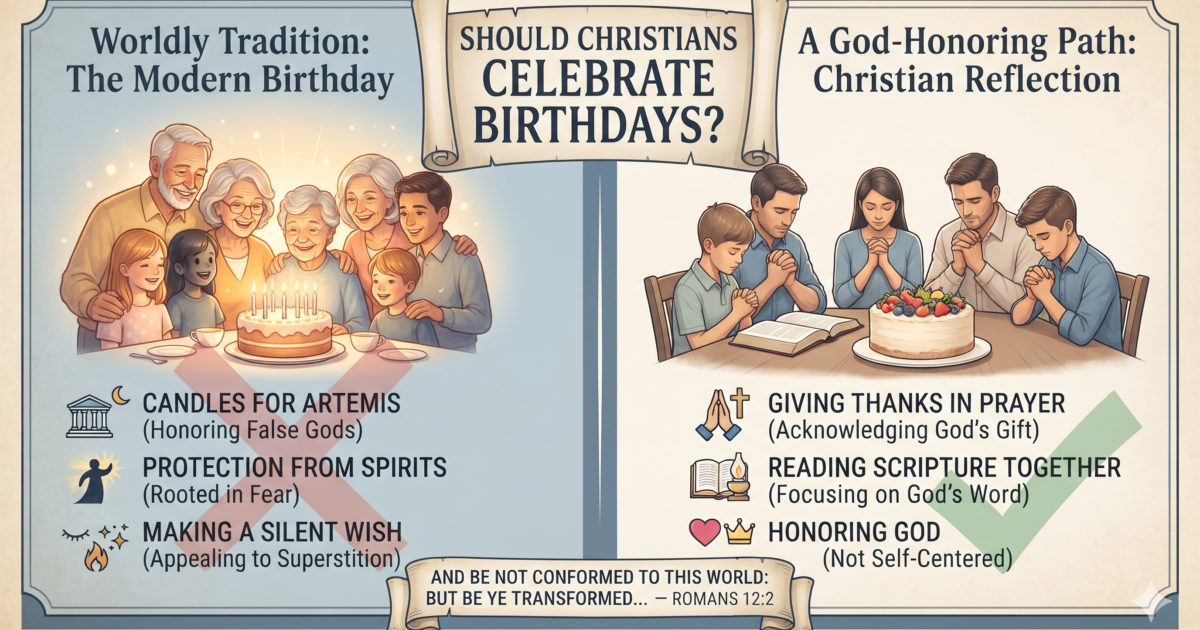
Every year, millions of people gather around a cake, light candles, sing, make a silent wish and blow the flames out. It looks harmless. Many Christian families do it without a second thought. But should Christians celebrate birthdays this way? Before we light the next candle, it is worth asking where these customs come from and what the Word of God says about them.
"And be not conformed to this world: but be ye transformed by the renewing of your mind, that ye may prove what is that good, and acceptable, and perfect, will of God." — Romans 12:2
Where do birthday candles and cake come from?
The birthday cake with candles did not come from the Bible or from the early Church. Historians point to pagan and folk roots:
- Candles for a goddess. One theory traces the candles to the early Greeks, "who used candles to honor the goddess Artemis' birth on the sixth day of every lunar month" (Wikipedia: Birthday cake). Scholars say this link has not been firmly established, but the theory itself shows how the custom has long been tied to honouring false gods.
- Protection from evil spirits. The modern cake with candles is traced to Kinderfest, an 18th-century German celebration for children, "where Germans believed that adults protected children from evil spirits attempting to steal their souls" (same source). The celebration was built around fear of spirits, not trust in God.
- The wish. Today the celebrant is "prompted to blow out the candles and make a wish" (Wikipedia: Birthday cake), and "superstition holds that the wish will be granted" (Wikipedia: Birthday).
Ask yourself: granted by whom? A wish made in silence over a flame is not a prayer to the Lord Jesus Christ. It is an appeal to luck, to fate, or to some unseen power. That is the very heart of superstition.
What the Bible says about superstition and wishes
God is clear that His people must have nothing to do with practices that look for help or blessing from anything other than Him:
"There shall not be found among you any one that maketh his son or his daughter to pass through the fire, or that useth divination, or an observer of times, or an enchanter, or a witch." — Deuteronomy 18:10
Reading omens, marking special days for luck, and expecting a ritual to make something happen belong to the same family of practices the Lord calls an abomination. A believer does not need a candle to carry a wish. We have direct access to the Father through Jesus Christ:
"Be careful for nothing; but in every thing by prayer and supplication with thanksgiving let your requests be made known unto God." — Philippians 4:6
Paul also tells us to "abstain from all appearance of evil" (1 Thessalonians 5:22), and asks, "what fellowship hath light with darkness?" (2 Corinthians 6:14).
The only two birthday parties in the Bible
The Bible records exactly two birthday celebrations, and both were held by people who did not know God. Both ended in death.
- Pharaoh's birthday. "And it came to pass the third day, which was Pharaoh's birthday, that he made a feast unto all his servants" — and at that feast the chief baker was hanged (Genesis 40:20-22).
- Herod's birthday. At Herod's birthday feast, the daughter of Herodias danced, and John the Baptist was beheaded (Matthew 14:6-10, Mark 6:21-28).
Not one of God's servants — not Abraham, Moses, David, the prophets, the apostles, nor our Lord Jesus — is ever recorded celebrating his own birthday.
What the early Church believed
This is not a new teaching. The early Christian teacher Origen (3rd century) wrote that "of all the holy people in the Scriptures, no one is recorded to have kept a feast or held a great banquet on his birthday. It is only sinners (like Pharaoh and Herod) who make great rejoicings over the day on which they were born" (quoted in the Catholic Encyclopedia, "Natal Day"). The early believers remembered the day a saint went home to the Lord, not the day he was born.
Scripture itself says: "A good name is better than precious ointment; and the day of death than the day of one's birth" (Ecclesiastes 7:1).
How the celebration deceives us
The danger of the birthday ritual is not the cake itself. It is what the ritual quietly teaches:
- It puts self at the centre. The day becomes "my day", my wish and my glory, when Scripture tells us to deny ourselves (Luke 9:23).
- It trains trust in luck. Children learn that blowing out every candle in one breath makes a wish come true. That is faith placed in a ritual instead of in God.
- It hides its roots. Because it feels innocent and everyone does it, few ever ask where it came from. Satan rarely comes with horns; he comes as an angel of light (2 Corinthians 11:14).
A better way to mark another year
Turning away from the candle and the wish does not mean ignoring God's goodness. Life is a gift from Him, and every year is a reason to thank Him. Instead of the world's ritual, a Christian family can:
- Give thanks in prayer for another year of life and grace: "So teach us to number our days, that we may apply our hearts unto wisdom" (Psalm 90:12).
- Read a Psalm together and pray a blessing over the person.
- Share a meal or give to someone in need, honouring God rather than self.
- Remember the day of new birth in Christ, the birthday that truly matters (John 3:3).
Walk in the light
We share this not to condemn anyone, but because we love God's people and want every home to be free from customs that do not honour the Lord. If you have practised these things without knowing, there is no shame in turning now. Pray about it, search the Scriptures, and let the Holy Spirit guide your family.
If you would like to talk or pray with us, send a prayer request or join us any Sunday at TNAU Church (Agri Chapel), Coimbatore.